

When Is a Sinus CT Considered for Symptoms That Keep Returning?
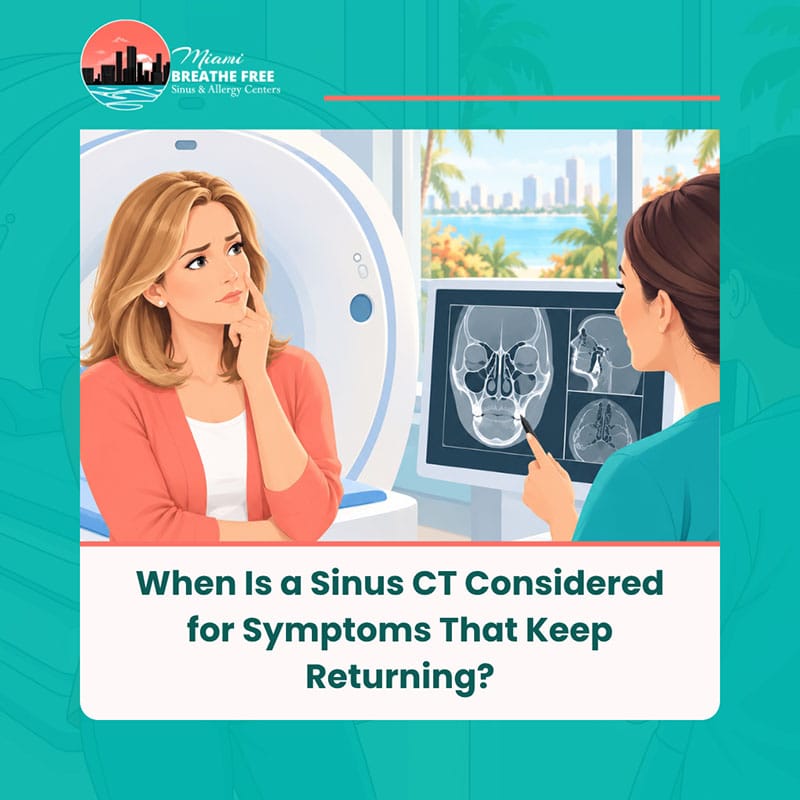
Recurring sinus symptoms, such as nasal congestion, difficulty breathing through the nose, postnasal drip, facial pressure, and a runny nose, can be frustrating, especially when they begin affecting daily activities, concentration, sleep, and overall comfort.
If your sinus symptoms keep returning despite appropriate initial treatment, a sinus CT scan may help identify anatomical changes or other findings that could be relevant to your symptoms.
A sinus CT scan provides detailed images of the sinus cavities, drainage pathways, and surrounding structures that may not be fully visible during a routine nasal examination.
At Miami Breathe Free, we help patients understand why sinus symptoms may persist or return and when a sinus CT scan might be useful in evaluating possible contributing factors.
What Is a Sinus CT Scan?
A computed tomography (CT) scan is a diagnostic imaging test that uses X-ray technology to create detailed cross-sectional images of structures inside the body, including the nose and paranasal sinuses.
Unlike traditional X-rays, which provide two-dimensional images, CT imaging allows healthcare providers to examine the complex anatomy of the sinuses from multiple views.
A sinus CT scan can help an ENT specialist evaluate:
- Sinus drainage pathways.
- Individual sinus cavities.
- The nasal septum.
- The turbinates.
- Surrounding bone and anatomical structures.
- Certain soft-tissue abnormalities.
- Areas of fluid buildup or thickening of the sinus lining.
During a sinus CT scan, an imaging system captures multiple X-ray measurements that are processed into detailed images of the sinuses.
Depending on the equipment used, patients may lie down, sit, or stand during the scan.
The procedure is generally brief and noninvasive, although the exact process and duration may vary by facility.
Because CT imaging uses ionizing radiation, your healthcare provider will consider whether the expected diagnostic benefits justify the exposure and whether imaging is necessary for your individual situation.
When Is a Sinus CT Scan Recommended for Recurring Symptoms?
Not every episode of nasal congestion, facial pressure, or sinus discomfort requires a CT scan.
A sinus CT may be considered when symptoms are persistent or recurrent, when the diagnosis remains uncertain, when complications are suspected, or when detailed anatomical information is needed for treatment planning.
Before recommending imaging, an ENT specialist typically considers your medical history, symptoms, examination findings, and response to previous treatment.
A sinus CT may be appropriate in certain situations, including:
- Symptoms lasting 12 weeks or longer: Persistent symptoms may raise concern for chronic rhinosinusitis, particularly when supported by objective findings of inflammation.
- Repeated episodes of sinus symptoms: Imaging may be considered in selected patients with suspected recurrent sinusitis, depending on their clinical history and examination findings.
- Abnormal nasal endoscopy findings: An abnormality identified during nasal endoscopy may require further evaluation.
- Symptoms that have not improved with appropriate treatment: CT imaging may help clarify the diagnosis or provide additional information for treatment planning.
- Persistent symptoms affecting primarily one side: Unilateral symptoms may warrant additional investigation to identify a possible structural or other underlying condition.
- Unexplained bloody nasal drainage: Recurrent or persistent bleeding, particularly from one side, may require further examination and, in selected cases, imaging.
A CT scan is not automatically necessary in any of these situations. Your provider will determine whether imaging is appropriate based on the overall clinical picture.
What Can a Sinus CT Scan Show if Symptoms Keep Returning?
A sinus CT scan can identify anatomical changes and other findings that may be relevant to recurring sinus symptoms.
However, imaging findings must be interpreted alongside your symptoms, medical history, and examination results.
Some abnormalities may be incidental and may not be responsible for the symptoms you are experiencing.
Changes in the Sinus Lining
A sinus CT scan may show:
- Thickening of the sinus lining, also called mucosal thickening.
- Fluid within the sinus cavities.
- Partial or complete opacification of a sinus.
These findings may be associated with inflammation.
However, a CT scan alone cannot reliably determine how long the changes have been present, whether an active infection exists, or whether the findings are responsible for your symptoms.
Your ENT will consider the imaging results together with your medical history and examination findings to determine their clinical significance.
Narrowed Sinus Drainage Pathways
The sinuses drain through relatively narrow openings that connect to the nasal passages.
Inflammation, swollen tissue, nasal polyps, or anatomical variations may narrow these drainage pathways and interfere with normal sinus ventilation and drainage.
A sinus CT scan can provide detailed views of drainage pathways that may not be fully visible during a routine nasal examination.
These images may help your ENT assess whether narrowing or obstruction could be relevant to persistent or recurring sinus symptoms.
However, narrowing seen on CT does not automatically mean it is causing symptoms.
A Deviated Septum
A deviated septum occurs when the wall of cartilage and bone separating the two nasal passages is displaced from the midline.
A sinus CT scan can show the position of the nasal septum and identify areas where a deviation narrows the nasal passage.
Depending on its location and severity, a deviated septum may contribute to nasal obstruction and, in some patients, other nasal or sinus symptoms.
However, many people have a slightly off-center septum without experiencing significant problems.
A CT scan alone cannot establish whether a septal deviation is responsible for recurring sinus symptoms.
Your ENT will consider the imaging findings alongside your symptoms and examination results.
Enlarged Turbinates
Turbinates are structures along the side walls of the nasal passages that help warm, humidify, and filter inhaled air.
They contain tissue that can become swollen because of allergies, irritants, infections, or other inflammatory conditions.
A sinus CT scan may show enlarged turbinates, a finding known as turbinate hypertrophy.
Enlarged turbinates may narrow the nasal passages and contribute to nasal congestion or breathing difficulties.
However, turbinate size can change over time, and imaging findings do not always reflect how obstructed a patient feels.
Your ENT may use the CT findings together with a nasal examination to determine whether turbinate enlargement is clinically significant.
Nasal Polyps or Other Soft-Tissue Abnormalities
Nasal polyps are soft, noncancerous growths associated with inflammation of the nasal and sinus lining.
They may contribute to symptoms such as:
- Nasal congestion or obstruction.
- Reduced sense of smell.
- Postnasal drip.
- Facial pressure.
- Difficulty breathing through the nose.
A sinus CT scan may show soft-tissue changes consistent with nasal polyps or other abnormalities affecting the nasal passages and sinuses.
However, CT imaging alone may not reliably distinguish polyps from every other type of soft-tissue growth.
An unusual growth, particularly one affecting only one side of the nose, may require additional evaluation.
Depending on the findings, your ENT may recommend nasal endoscopy, MRI, or a biopsy to determine the nature of the abnormality.
Dental-Related Sinus Inflammation
The roots of the upper teeth are located close to the maxillary sinuses, which sit behind the cheeks.
In some cases, dental infections, tooth extractions, implants, or other dental conditions may contribute to inflammation in a nearby maxillary sinus.
A sinus CT scan may reveal findings that raise suspicion for a dental source of sinus inflammation.
These may include changes affecting the maxillary sinus or abnormalities near the roots of the upper teeth.
However, a sinus CT does not replace a dental examination or dedicated dental imaging when a dental cause is suspected.
Additional evaluation by a dental professional may be needed.
Fungal Sinus Conditions
Certain fungal sinus conditions can affect the sinus cavities and may be associated with persistent or recurring symptoms.
Some CT findings, such as particular patterns of sinus opacification or areas of increased density, may raise suspicion for a fungal sinus condition.
However, imaging alone generally cannot confirm the diagnosis or determine the specific type of fungal disease.
Depending on the suspected condition, additional evaluation may include nasal endoscopy, examination of tissue, or other diagnostic testing.
Your ENT will consider the imaging findings alongside your symptoms and other clinical information before recommending further evaluation or treatment.
An Uncommon Growth or Mass
Most recurring sinus symptoms are not caused by a tumor.
However, a sinus CT scan may occasionally reveal an unusual growth, an area of abnormal soft tissue, or changes involving the surrounding bone.
If an abnormality is identified, further testing may be necessary to determine its nature.
Depending on the findings, your provider may recommend MRI, nasal endoscopy, or a biopsy.
Certain symptoms deserve particular attention.
Persistent one-sided nasal obstruction, unexplained facial numbness, or recurrent one-sided nasal bleeding should be evaluated by an ENT specialist.
Seek urgent medical attention if you develop new vision changes, significant swelling around the eye, or severe, rapidly worsening symptoms.
These symptoms may indicate a condition that requires prompt assessment. The appropriate imaging or testing will depend on the clinical findings.
Conclusion: Understanding Why Sinus Symptoms Keep Returning and How a Sinus CT Can Help
Recurring sinus symptoms can have several possible causes, including inflammation, anatomical variations, nasal polyps, and other conditions affecting the nose or sinuses.
A sinus CT scan can provide detailed information about sinus anatomy and identify findings that may be relevant to persistent or recurring symptoms.
However, CT imaging does not automatically establish the cause of symptoms, confirm an active infection, or determine which treatment is necessary.
The most appropriate approach depends on your medical history, symptoms, examination findings, and response to previous treatment.
Miami Breathe Free provides ear, nose, and throat care services for patients in Miami and surrounding communities.
If you are experiencing persistent or recurring sinus symptoms that affect your breathing, sleep, or daily comfort, get in touch with our team to discuss possible contributing factors, whether a sinus CT scan may be appropriate, and available treatment or symptom management options.