

Why Can Nasal Congestion Return Quickly After Decongestants Wear Off?
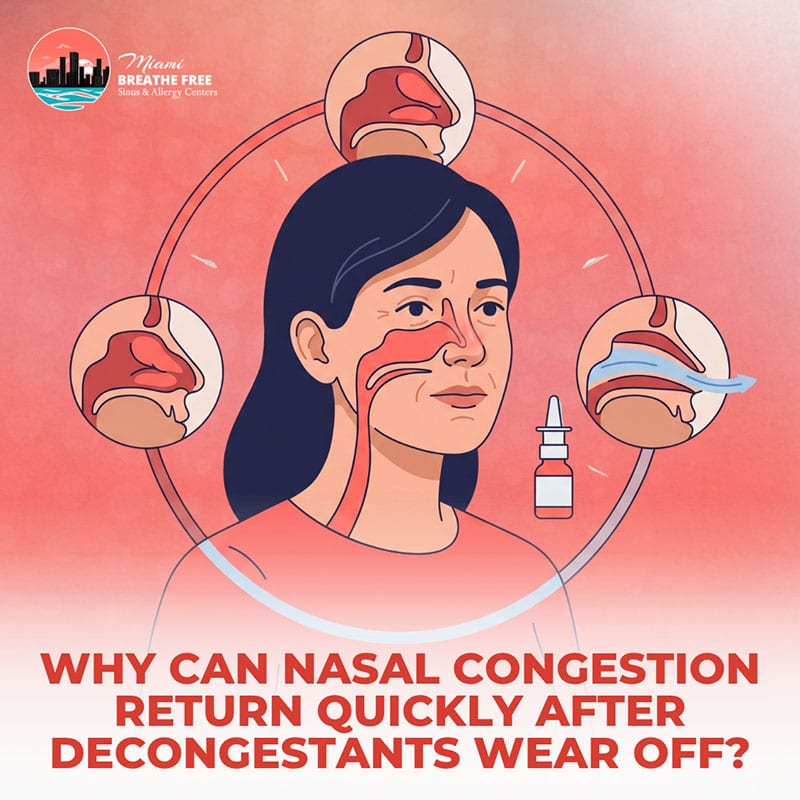
A nasal decongestant may temporarily make a blocked nose feel significantly clearer. Once the medication wears off, however, congestion can return—sometimes within several hours.
This does not always mean the medication caused the congestion. Often, it means the allergy, infection, inflammation, or structural problem responsible for the blockage is still present. In other cases, overusing certain topical decongestant sprays can cause rebound congestion, making the nose feel increasingly blocked between doses.
At Miami Breathe Free Sinus and Allergy Centers, patients receive evaluations intended to identify why congestion keeps returning and which treatment options may be appropriate.
Why Does Congestion Return After a Decongestant Wears Off?
Nasal congestion develops when tissue inside the nose becomes swollen, narrowing the space available for airflow. Increased mucus may contribute, but swelling is often a major reason the nose feels blocked.
Topical nasal decongestants temporarily narrow blood vessels in the nasal lining. This reduces tissue swelling and can allow air to move more freely.
As the medication wears off, the blood vessels are no longer constricted. If the original cause of the inflammation remains, the swelling and blocked sensation may return.
A return of the original symptoms after one properly used dose is not necessarily rebound congestion. True rebound congestion is associated with using certain topical decongestants too frequently or for longer than directed.
What Is Rebound Congestion?
Rebound congestion, medically known as rhinitis medicamentosa, is nasal obstruction caused or worsened by overusing topical nasal decongestants.
Products containing ingredients such as oxymetazoline or topical phenylephrine can provide short-term relief. With repeated or prolonged use, however, the nasal lining may become irritated and inflamed. The medication may also seem to provide less relief, encouraging more frequent use.
This can create a cycle:
- The spray temporarily reduces nasal swelling.
- Congestion returns as the medication wears off.
- Another dose is used to reopen the nasal passages.
- Increasing irritation and inflammation make the blockage harder to control.
- The person begins relying on the spray to breathe comfortably.
According to Cleveland Clinic’s guidance on rhinitis medicamentosa, rebound congestion typically affects the nasal passages without causing the broader eye, throat, or ear symptoms associated with many other forms of rhinitis.
How Can You Tell Whether It Is Rebound Congestion?
Possible signs include:
- Congestion that returns rapidly between doses
- Increasing use of a nasal decongestant spray
- Feeling unable to breathe comfortably without the spray
- Needing more frequent doses to achieve the same relief
- Persistent blockage after the original cold or allergy flare has improved
- Congestion that has gradually worsened during extended spray use
These signs can suggest rebound congestion, but they do not confirm it. Allergies, chronic rhinitis, a deviated septum, enlarged turbinates, nasal polyps, and other conditions may produce similar symptoms.
An evaluation can help determine whether the medication, an underlying condition, or both are contributing.
Which Nasal Sprays Cause Rebound Congestion?
Rebound congestion is primarily associated with topical nasal decongestants, including sprays containing oxymetazoline or topical phenylephrine.
Not every nasal spray works in the same way.
- Topical decongestant sprays temporarily constrict blood vessels and may cause rebound congestion when overused.
- Corticosteroid nasal sprays reduce inflammation over time and are not generally associated with rebound congestion when used as directed.
- Antihistamine nasal sprays help manage certain allergy or rhinitis symptoms and work differently from decongestants.
- Saline sprays and rinses contain no decongestant medication and do not cause rhinitis medicamentosa.
Because packaging can look similar, check the active ingredient rather than relying only on the product name or the word “nasal spray.”
How Long Can You Use a Decongestant Nasal Spray?
Many over-the-counter decongestant sprays are labeled for no more than three consecutive days.
For example, MedlinePlus advises that oxymetazoline should not be used for longer than three days. Using it more frequently or longer than directed may cause congestion to worsen or return.
Always follow the instructions for the specific product. Do not increase the dose or frequency because the medication seems less effective.
If congestion remains after the labeled treatment period, a healthcare provider can evaluate whether another treatment may be more appropriate.
Are Oral Decongestants Different From Nasal Sprays?
Oral and topical decongestants work differently.
Topical sprays act directly inside the nose and often begin working relatively quickly. Oral decongestants circulate through the body and can affect blood vessels beyond the nasal passages.
Oral decongestants are not typically associated with rhinitis medicamentosa, but they can cause other side effects, including:
- Increased blood pressure
- A faster or irregular heartbeat
- Nervousness or restlessness
- Difficulty sleeping
- Difficulty urinating
- Headache or dizziness
These medications may not be appropriate for people with certain heart, blood-pressure, thyroid, prostate, eye, or other medical conditions. They may also interact with prescription medications.
Pregnant or breastfeeding patients and people with underlying health conditions may want to consult a healthcare professional before using a decongestant.
What Else Can Cause Recurring Nasal Congestion?
Recurring congestion is not always caused by medication. Possible underlying factors include:
Allergies
Allergies can cause inflammation, sneezing, itching, watery eyes, and nasal drainage. In South Florida, pollen, mold, and indoor allergens such as dust mites may contribute during different parts of the year.
Chronic rhinosinusitis
Long-lasting inflammation in the nose and sinuses may cause congestion, drainage, facial pressure, and reduced smell. Symptoms lasting 12 weeks or longer may warrant evaluation for chronic rhinosinusitis.
Nonallergic rhinitis
Smoke, fragrances, weather changes, humidity, temperature shifts, and other irritants can trigger nasal symptoms without an allergic reaction.
Structural obstruction
A deviated septum, enlarged turbinates, nasal valve dysfunction, or nasal polyps may restrict airflow. Medication may reduce accompanying inflammation without correcting the underlying structural narrowing.
Infection
Colds and other respiratory infections can temporarily inflame the nasal passages. A bacterial infection is only one possible cause, and discolored mucus alone does not establish that antibiotics are needed.
How Can You Break the Rebound-Congestion Cycle?
If rebound congestion is suspected, avoid repeatedly increasing the spray dose. A healthcare provider can recommend how to reduce or discontinue the medication safely.
Stopping abruptly can temporarily make symptoms feel worse for some people. Depending on the circumstances, a provider may recommend gradually reducing use and using other treatments while the nasal lining recovers.
Options may include:
- Corticosteroid nasal sprays
- Antihistamine nasal sprays
- Saline sprays or irrigation
- Allergy evaluation and treatment
- Management of chronic nasal or sinus inflammation
- Treatment of an underlying structural obstruction
Recovery may take anywhere from several days to several weeks. The timeline varies based on how long the spray was used, the condition of the nasal lining, and whether another cause of congestion remains.
For nasal irrigation, use distilled, sterile, or previously boiled and cooled water. Clean the irrigation device according to its instructions.
How Can an ENT Identify the Underlying Cause?
Persistent congestion is a symptom rather than a diagnosis. An ENT evaluation may include questions about:
- When the congestion started
- Which medications and sprays are being used
- How frequently and how long a decongestant has been used
- Whether one or both sides are affected
- Whether symptoms change with allergy exposure
- Whether facial pressure, drainage, reduced smell, or recurrent infections are present
A nasal examination may identify inflammation, enlarged turbinates, nasal polyps, structural narrowing, or other factors affecting airflow. Nasal endoscopy, allergy testing, or imaging may be considered when clinically appropriate.
When Should You Seek Medical Care?
Consider scheduling an evaluation if:
- Congestion persists after using a medication for the labeled duration.
- You feel unable to breathe comfortably without a decongestant spray.
- Congestion interferes with sleep or daily activities.
- Symptoms continue for several weeks or repeatedly return.
- One side remains persistently blocked.
- You experience reduced smell, recurring sinus symptoms, or frequent nosebleeds.
Seek prompt medical attention for difficulty breathing, swelling around the eyes, vision changes, severe headache, confusion, facial numbness, significant facial swelling, or persistent bloody nasal discharge.
Frequently Asked Questions
Is congestion returning after one dose the same as rebound congestion?
No. Symptoms may return because the medication’s temporary effect has ended while the original condition remains. Rebound congestion is associated with repeated or prolonged use of certain topical decongestants.
Can corticosteroid nasal sprays cause rebound congestion?
Corticosteroid sprays are not generally associated with rhinitis medicamentosa when used as directed. They work by reducing inflammation rather than rapidly constricting nasal blood vessels.
Can saline nasal spray cause rebound congestion?
No. Saline sprays contain no topical decongestant medication and do not cause rebound congestion.
Is rebound congestion permanent?
It is usually reversible, but recovery can take time. A provider can help determine how to discontinue the medication and manage the original cause of congestion.
Why does my nose remain blocked after stopping the spray?
The nasal lining may need time to recover from irritation and inflammation. An untreated condition such as allergies, chronic rhinitis, or structural narrowing may also still be present.
Look Beyond Temporary Congestion Relief
If a decongestant clears the nose for only a few hours, the original cause of the congestion may still be present. If the spray has been used longer or more frequently than directed, rebound congestion may also be contributing.
Identifying whether allergies, chronic inflammation, medication overuse, or structural narrowing is responsible can help guide a more appropriate long-term plan.
Schedule an evaluation with Miami Breathe Free Sinus and Allergy Centers to discuss recurring nasal congestion and available treatment options.